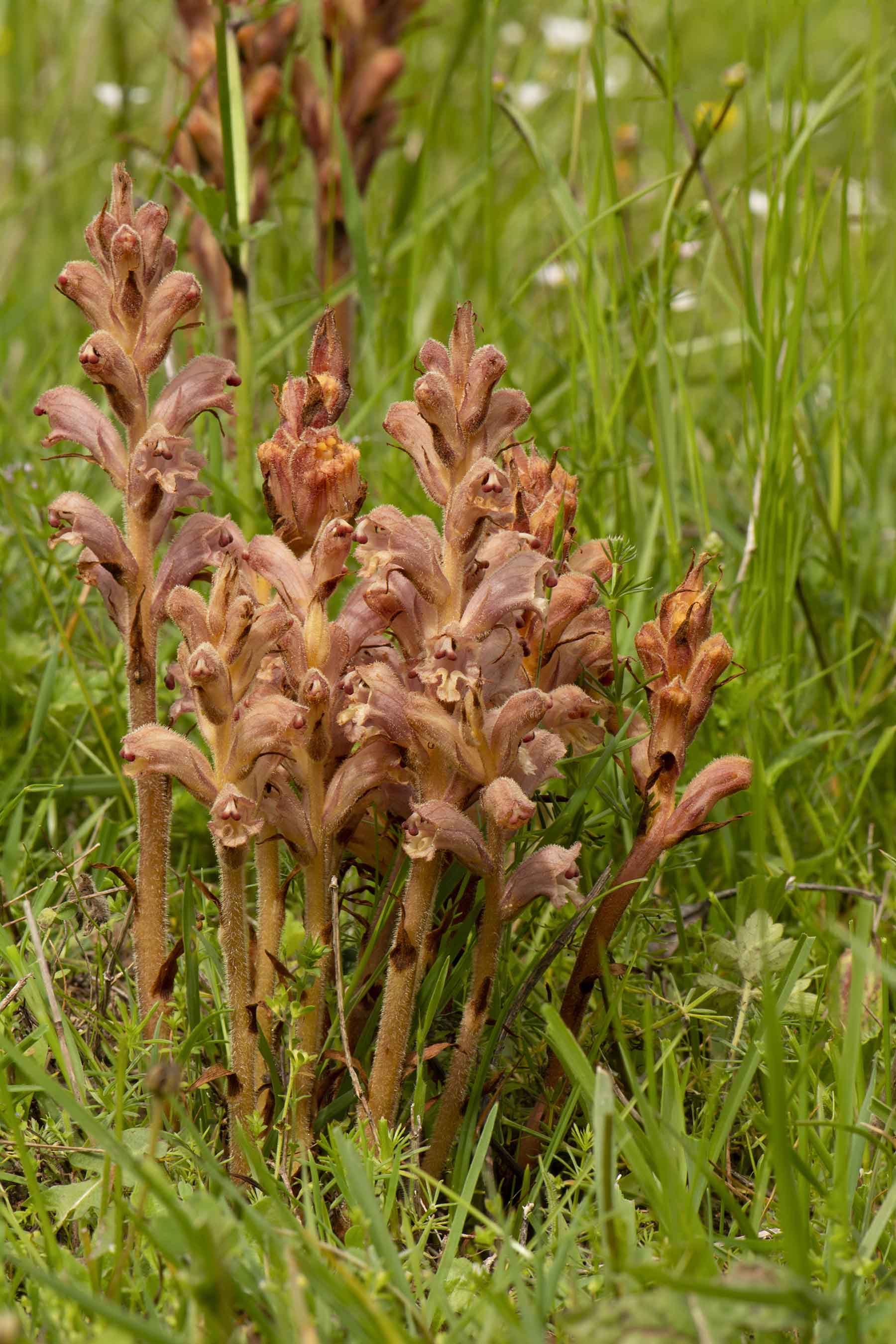
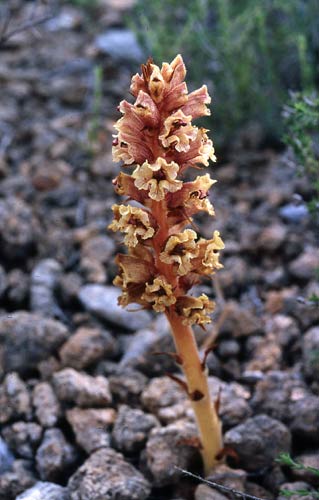
Orobanchaceae, the broomrapes, is a family of mostly parasitic plants of the order Lamiales, with about 90 genera and more than 2000 species. Many of these genera (e.g., Pedicularis, Rhinanthus, Striga) were formerly included in the family Scrophulariaceae sensu lato. With its new circumscription, Orobanchaceae forms a distinct, monophyletic family. From a phylogenetic perspective, it is defined as the largest crown clade containing Orobanche major and relatives, but neither Paulownia tomentosa nor Phryma leptostachya nor Mazus japonicus.
The Orobanchaceae are annual herbs or perennial herbs or shrubs, and most (all except Lindenbergia, Rehmannia and Triaenophora) are parasitic on the roots of other plants—either holoparasitic or hemiparasitic (fully or partly parasitic). The holoparasitic species lack chlorophyll and therefore cannot perform photosynthesis.
Description
Orobanchaceae is the largest of the 20–28 dicot families that express parasitism. Apart from a few non-parasitic taxa, the family displays all types of plant parasitism: facultative parasite, obligate parasite, hemiparasites, and holoparasites.
Roots and stems
Parasitic plants are attached to their host by means of haustoria, which transfer nutrients from the host to the parasite. Only the hemiparasitic species possess an additional extensive root system referred to as the lateral or side haustoria. In most holoparasitic species there is a swollen mass of short, bulky roots or one big swollen haustorial organ, which may be simple or composite, commonly called the terminal or primary haustorium.
Plants are reduced to short vegetative stems, their alternate leaves are reduced to fleshy, tooth-like scales, and have multicellular hairs interspersed with glandular hairs.
The hemiparasitic species (transferred from Scrophulariaceae) with green leaves are capable of photosynthesis, and may be either facultative or obligate parasites.
Flowers
The hermaphroditic flowers are bilaterally symmetrical and grow either in racemes or spikes or singly at the apex of the slender stem. The tubular calyx is formed by 2–5 united sepals. There are five united, bilabiate petals forming the corolla and they may be yellowish, brownish, purplish, or white. The upper lip is two-lobed, the lower lip is three-lobed. There are two long and two short stamens on slender filaments, inserted below the middle, or at the base of the corolla tube, alternating with the lobes of the tube. A fifth stamen is either sterile or lacking completely. The anthers dehisce via longitudinal slits. The pistil is one-celled. The ovary is superior. The flowers are pollinated by insects or birds (e.g., hummingbirds, as in Castilleja).
Fruits
The fruit is a dehiscent, non-fleshy, 1-locular capsule with many very minute endospermic seeds. Fruits of Orobanchaceae are small and abundant and can produce between 10,000–1,000,000 seeds per plant. These are dispersed by the wind over long distances, which increases their chances of finding a new host.
Taxonomy
The taxon was first described in 1799 by Étienne Pierre Ventenat as Orobanchoideae. The family name Orobanchaceae is a conserved name. Despite the similar morphological traits found in both Scrophulariaceae and Orobanchaceae, the latter is now considered a separate monophyletic taxon, on both molecular and mophological grounds. The 2016 APG IV system expanded Orobanchaceae to include genera previously placed in Scrophulariaceae, so that the family absorbed the former Lindenbergiaceae and Rehmanniaceae. These two former families may be treated as tribes. Molecular phylogenetic studies show that they are sisters to the other Orobanchaceae genera:
Evolution
Development of the haustoria was a significant evolutionary event that allowed for the advancement of parasitic plants. The holoparasitic clade, Orobanche, delineates the first transition from hemiparasitism to holoparasitism within Orobanchaceae.
Genomics
The parasitism and its different modes have been suggested to have an impact on genome evolution, with increased DNA substitution rates in parasitic organisms compared to non-parasitic taxa. For example, holoparasite taxa of Orobanchaceae exhibit faster molecular evolutionary rates than confamilial hemiparasites in three plastid genes.
In a study comparing the rates of molecular evolution of parasitic versus non parasitic taxa for 12 pairs of angiosperm families — including Apodanthaceae, Cytinaceae, Rafflesiaceae, Cynomoriaceae, Krameriaceae, Mitrastemonaceae, Boraginaceae, Orobanchaceae, Convolvulaceae, Lauraceae, Hydnoraceae, and Santalaceae/Olacaceae —, parasitic taxa evolve on average faster than their close relatives for mitochondrial, plastid, and nuclear genome sequences. Whereas Orobanchaceae fit to this trend for plastid DNA, they appear to evolve slower than their non parasitic counterpart in comparisons involving nuclear and mitochondrial DNA.
Genera
As of February 2025, Plants of the World Online accepted 99 genera. Three further genera are accepted by other sources, and are included in the following list.
Genera by life history trait
Orobanchaceae genera listed according to their life history trait.
- Bartsiella
- Bornmuellerantha
- Brachystigma
- Brandisia
- Cyclocheilon
- Kopsiopsis
- Macrosyringion
- Odontiella
Non-parasitic
- Lindenbergia
- Rehmannia
- Triaenophora
Hemiparasitic
Holoparasitic
Distribution
The family Orobanchaceae has a cosmopolitan distribution, found mainly in temperate Eurasia, North America, South America, parts of Australia, New Zealand, and tropical Africa. The only exception to its distribution is Antarctica, though some genera may be found in subarctic regions.
Ecology
This family has tremendous economic importance because of the damage to crops caused by some species in the genera Orobanche and Striga. They often parasitize cereal crops like sugarcane, maize, millet, sorghum, and other major agricultural crops like cowpea, sunflower, hemp, tomatoes, and legumes. Because of the ubiquitous nature of these particular parasites in developing countries, it is estimated to affect the livelihood of over 100 million people, killing 20 to 100 percent of crops depending on infestation.
Some genera, especially Cistanche and Conopholis, are threatened by human activity, including habitat destruction and over-harvesting of both the plants and their hosts.
Research for this plant family can often be difficult due to its permit requirements for collection, travel, and research.
Notes
References
External links
- Wiki of Orobanchaceae
- Parasitic Plant Connection: Orobanchaceae