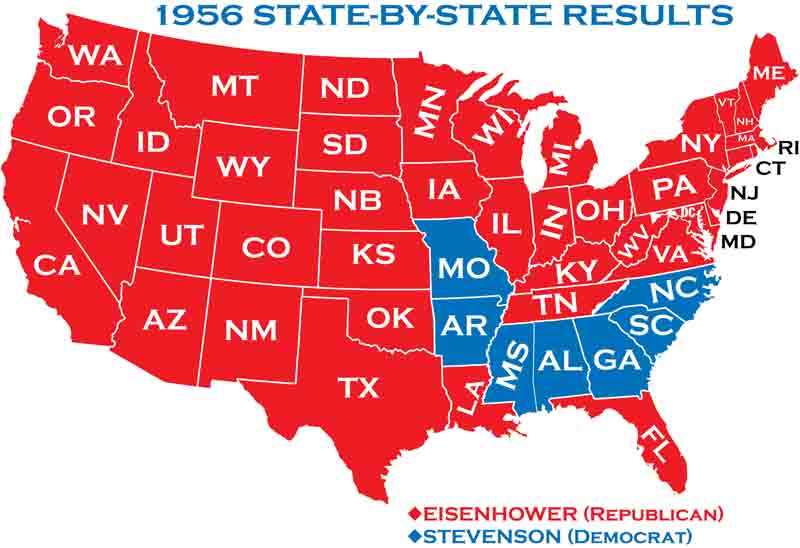
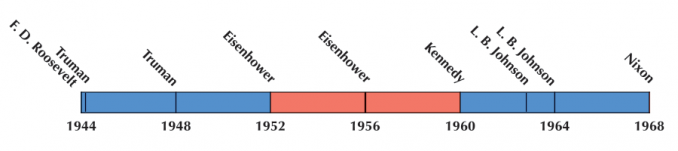
The 1956 United States House of Representatives elections was an election for the United States House of Representatives to elect members to serve in the 85th United States Congress. They were held for the most part on November 6, 1956, while Maine held theirs on September 10. They coincided with the re-election of President Dwight D. Eisenhower.
With no major national issues and the economic upswing of the 1950s in full force, voters generally chose to uphold the status quo, keeping the Republican president and the Democratic Congress.
Overall results
410 incumbent members sought reelection, but 6 were defeated in primaries and 15 defeated in the general election for a total of 389 incumbents winning. As of 2025, these are the earliest House elections in which a still-living Representative was elected (Merwin Coad of Iowa).
Special elections
In these special elections, the winner was seated during 1956 or before January 3, 1957; ordered by election date.
Alabama
Arizona
Arkansas
California
Colorado
Connecticut
Delaware
Florida
Georgia
Idaho
Illinois
Indiana
Iowa
Kansas
Kentucky
Louisiana
Maine
Maryland
Massachusetts
Michigan
Minnesota
Mississippi
Missouri
Montana
Nebraska
Nevada
New Hampshire
New Jersey
New Mexico
New York
North Carolina
North Dakota
Ohio
Oklahoma
Oregon
Pennsylvania
Rhode Island
South Carolina
South Dakota
Tennessee
Texas
Utah
Vermont
Virginia
Washington
West Virginia
Wisconsin
Wyoming
Non-voting delegates
Alaska Territory
Hawaii Territory
See also
- 1956 United States elections
- 1956 United States Senate elections
- 1956 United States presidential election
- 1956 United States gubernatorial elections
- 84th United States Congress
- 85th United States Congress
Notes
References
Works cited
- Abramson, Paul; Aldrich, John; Rohde, David (1995). Change and Continuity in the 1992 Elections. CQ Press. ISBN 0871878399.